


 PDF Version
In a few years, Nutanix NCSC-Level-1 certification exam has become a very influential exam which can test computer skills.The certification of Nutanix certified engineers can help you to find a better job, so that you can easily become the IT white-collar worker,and get fat salary.
However, how can pass the Nutanix NCSC-Level-1 certification exam simple and smoothly? ITCertMaster can help you solve this problem at any time.
ITCertMaster is a site which providing materials of International IT Certification. ITCertMaster can provide you with the best and latest exam resources.The training questions of Nutanix certification provided by ITCertMaster are studied by the experienced IT experts who based on past exams. The hit rate of the questions is reached 99.9%, so it can help you pass the exam absolutely. Select ITCertMaster, then you can prepare for your Nutanix NCSC-Level-1 exam at ease.
Our materials of Nutanix NCSC-Level-1 international certification exam is the latest collection of exams' questions, it is covering a comprehensive knowledge points. It is the best assistant for you preparation about the exam. You just need to spend 20-30 hours to remember the content of the questions we provided.
All customers that purchased the materials of Nutanix NCSC-Level-1 exam will receive the service that one year's free update, which can ensure that the materials you have is always up to date. If you do not pass the exam after using our materials, you can provide the scanning items of report card which provided by authorized test centers (Prometric or VUE) . we will refund the cost of the material you purchased after verified, We guarantee you interests absolutely.
Before you select ITCertMaster, you can try the free download that we provide you with some of the exam questions and answers about Nutanix NCSC-Level-1 certification exam. In this way, you can know the reliability of ITCertMaster.
ITCertMaster is the best choice which can help you to pass the Nutanix certification exams, it will be the best guarantee for your exam.
No matter what level of entry you are for your Nutanix Certification, you will pass your NCSC-Level-1 exam, FAST!
Quickly select ITCertMaster please! Select ITCertMaster is equivalent to choose a success. With it you can complete your dreams quickly!
Easy and convenient way to buy: Just two steps to complete your purchase, we will send the product to your mailbox quickly, you only need to download e-mail attachments to get your products.
Nutanix NCSC-Level-1 Exam Syllabus Topics:
| Section | Objectives |
|---|---|
| Topic 1: Nutanix Platform Fundamentals | - Acropolis Operating System (AOS)
|
| Topic 2: Support & Lifecycle | - Licensing
|
| Topic 3: Networking & Cloud Extension | - Software-defined Networking
|
| Topic 4: Prism Management | - Prism Central
|
| Topic 5: Advanced Services | - Containers (Karbon)
|
| Topic 6: Storage & Data Services | - Nutanix Volumes & Files
|
| Topic 7: Automation & Cloud Services | - Nutanix Calm
|
Nutanix Certified Services Consultant (NCSC): Level 1 Sample Questions:
1. To prepare for a new Nutanix installation, a consultant downloads the Foundation VM, imports the VM to their Desktop Virtualization Solution, and powers on the VM. The IPv4 static address on the host workstation and the Foundation VM have been configured, but pings between them fail.
Which two troubleshooting steps should the consultant perform? (Choose two.)
A) Verify the virtual NIC in the Foundation VM is bound to the correct physical Host adapter.
B) Remove and re-import the Foundation VM to ensure the virtual NIC is set to Host-Only.
C) Verify the virtual NIC in the Foundation VM is bound to the correct wireless network adapter.
D) Confirm the IP addresses and subnet masks are correct.
2. After a recent installation using a flat switch, a consultant notices issues migrating the Nutanix nodes to the customer's network. The customer states that they are using VLANs on the production switch but not on the dedicated switch for IPMI. The customer does not require a manual configuration of the host and CVM.
What network changes need to be made to correct the issues?
A) Use tagged VLANs for the CVM and host and access mode for IPMI.
B) Use Native VLANs for the CVM and host and trunk mode for IPMI.
C) Us untagged VLANs for the CVM and host and trunk mode for IPMI.
D) Use Native VLANs for the CVM and host and access mode for IPMI.
3. A consultant finishes creating a new ESXi cluster. The consultant connects to the nodes via laptop and a personal flat switch. The host/CVM network is on VLAN 23. The customer has the native VLAN on the ToR switches set to 23.
The customer wants to use LACP. Before placing the nodes on the customer network, the consultant tags VLAN 23 for each host and CVM. The consultant connects the nodes to the customer network and finds that they are unreachable.
What is causing this issue?
A) The hosts have not been migrated to a vSphere Distributed Switch.
B) Under the vSwitch0 settings, the consultant did not select Route based on IP hash.
C) The customer has LACP fallback enabled on switch ports.
D) The host and CVM are incorrectly configured.
4. A customer wants to use NIC teaming on an ESXi host using a vSphere Standard Switch configured with the Route based on physical NIC load load balancing option. The customer does not see the option when editing the Teaming and Failover settings for the switch.
How should the consultant resolve this issue?
A) Install a vCenter server to manage the switch
B) Add another physical NIC to the team.
C) Add a vSphere Distributed Switch
D) Change the load balancing option on the switch.
5. Refer to the exhibits.
A consultant is trying to test port failover on the node shown in the first exhibit. A continuous ping test is performed to the host. The consultant shuts down one of the links, after which the host ping request times out. The consultant tries to troubleshoot the issue with the customer and sees the information shown in the second exhibit on their Cisco Switches: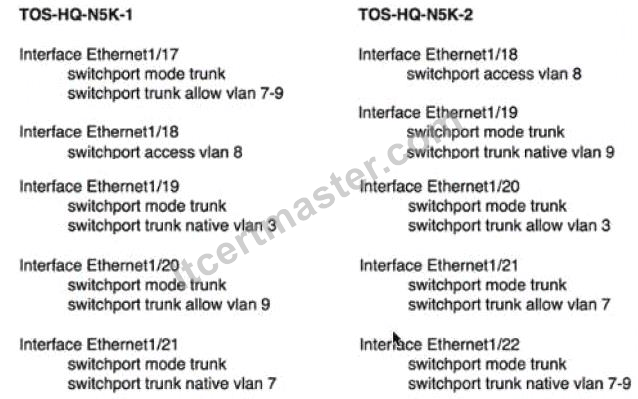
What is causing the issue?
A) PortFast is not enabled on the port connected to the host.
B) Bad SPF+ cables are on the active interface.
C) There is a Native VLAN mismatch on the switchport.
D) The wrong VLAN is tagged on the host.
Solutions:
| Question # 1 Answer: A,D | Question # 2 Answer: D | Question # 3 Answer: A | Question # 4 Answer: C | Question # 5 Answer: C |
 783 Customer Reviews


